- Blog
- 2026/11/04
Careful with Watering, Yet Your Succulents and Caudiciforms Still Rot?
Many growers know this story: you only water when the soil is dry and keep the plant somewhere airy, yet it still turns soft and mushy, with roots that have gone black. If careful care still ends in root rot, the problem often isn’t how you look after the plant — it’s the pot.
A pot decides how water drains, how air moves, and how long it can serve your plant. Choosing the right one is among the easiest things a beginner can do, and it goes a long way toward fewer losses. Below, we look at choosing a succulent pot from three angles.
Raised Drainage Holes Keep Water from Pooling at the Bottom
Most succulents and caudiciforms handle drought well, but their roots don’t like sitting in wet soil for long. If water can’t drain fully from the bottom of the pot, the soil stays damp and short on air, and the roots can easily suffocate and rot.
When the drainage holes sit flat against a table or saucer, water gets trapped at the outlet and drains slowly. Raise the base and lift the holes off the surface, and water flows out more easily. The gap underneath also lets air circulate, which reduces standing water and helps the soil dry faster!
So when choosing a pot, don’t just check whether it has drainage holes — flip it over, too. Is the base raised? Are there several holes, evenly spaced? These two details directly affect how well water drains.
Thick Walls Stand Up to Knocks When Repotting and Moving
Once drainage is sorted, look at how durable the pot itself is. Succulents and caudiciforms grow slowly, so one pot often stays in use for years — through repotting, rearranging and moving in and out. Thin pots can warp along the way, and an accidental bump may crack them.
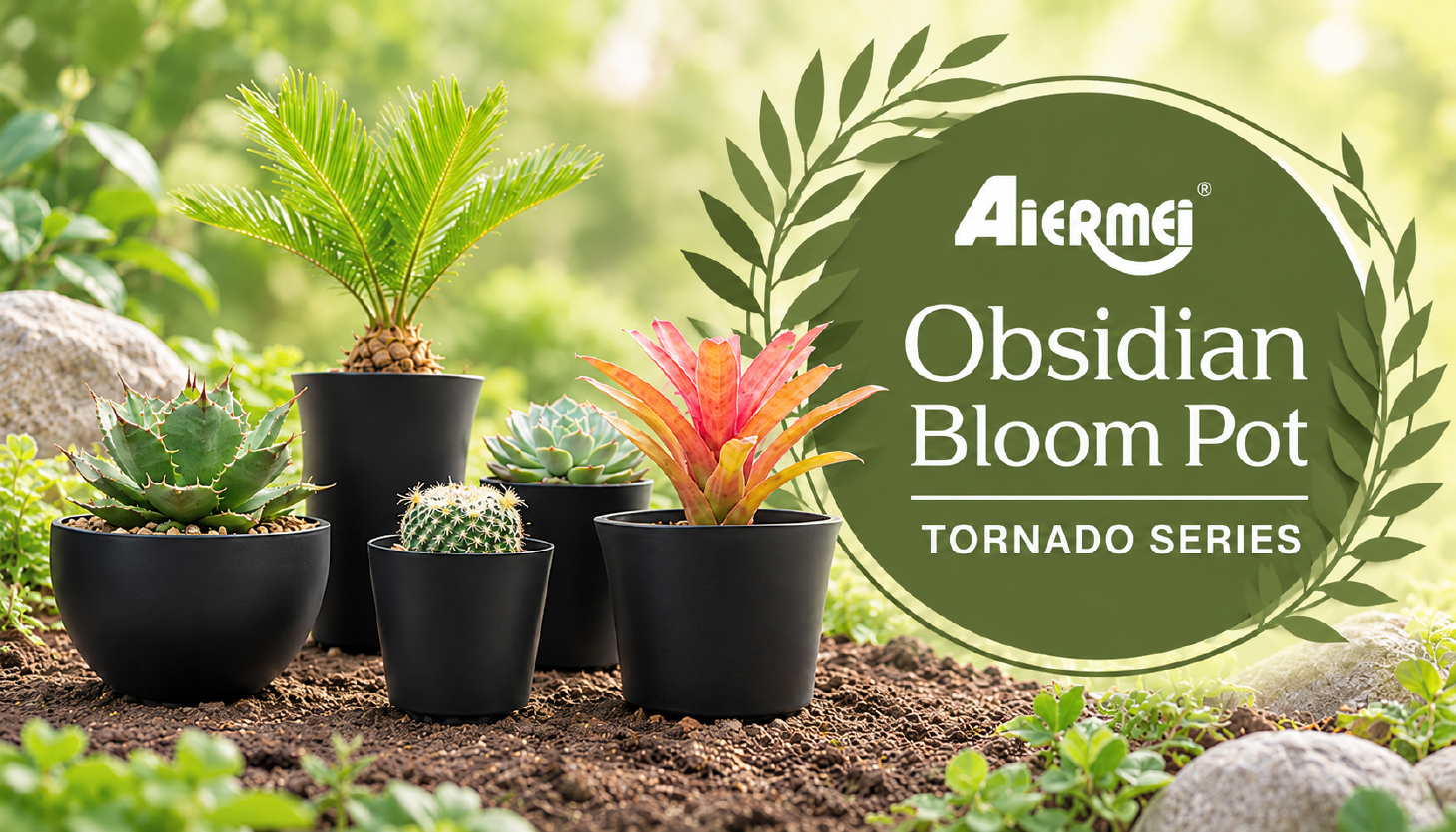
A thick-walled pot is structurally steadier, less likely to deform under pressure, and better able to handle everyday knocks. Take the Aiermei Tornado Series - Obsidian Bloom Pot as an example: wall thickness ranges from 0.5 to 0.8 cm, yet the lightweight plastic is easy to lift, so moving and repotting are simple! With a weather-resistant design that resists oxidation and cracking, it’s well suited to long-term growing!
Two Common Beginner Mistakes When Choosing Pots
Even with drainage and wall thickness in mind, beginners can still slip up at the pot-picking stage. It usually comes down to one of these two situations:
• Planting directly into a decorative pot with no drainage hole
Many people buy an attractive ceramic or cement pot, don’t check whether there’s a hole in the bottom, and plant straight into it. Water can’t escape after watering, and roots left sitting in water are prone to rot. If you love this kind of outer pot, plant first in a plastic pot with drainage holes, then set the whole pot inside the decorative one (the double-potting method). Remember to pour out any collected water after watering.
• Mixing succulents and caudiciforms with different needs in one pot
If plants with different water needs share one pot (caudiciforms, for example, usually need a longer dry period than some succulents), a single watering routine can leave some plants waterlogged and others too dry. Try to group species with similar drought tolerance, or simply plant them separately.
At a Glance: Standard Nursery Pots vs. the Aiermei Tornado Series
| Feature | Standard Nursery Pots | Aiermei Tornado Series |
| Drainage holes | Usually close to the table or saucer; varies by style | Multiple holes on a raised base for easier drainage |
| Wall design | Mostly thin and light; varies by style | Thick, weather-resistant and impact-resistant walls |
| Durability | Needs more care with long-term use or frequent moving | Weather-resistant, lightweight and durable for long-term growing |
| Appearance | Mainly practical | Matte finish with a simple Japanese-inspired shape |
Indoors or Outdoors? Where You Place It Matters Too
Indoor spaces usually get less light and airflow than outdoor ones, so water evaporates more slowly. Indoors, favor styles with more drainage holes and a clearly raised base to help moisture escape faster and lower the risk of root rot. On a windowsill or desk, pair the pot with a saucer to keep drained water off the surface.
Outdoors, with good airflow and plenty of sun, drainage is less of a concern — but watch for two things. Under strong summer sun, dark pots heat up faster, so avoid direct sun from noon through the afternoon, or choose a lighter color. In windy areas, pick a style with a wider mouth and a steadier center of gravity so it’s less likely to blow over.
Aiermei Tornado Series: Choose a Size by Plant Size
The Aiermei Tornado Series comes in several styles and sizes, so you can pick by plant size:
| Model | Size | Diameter x Height | Wall Thickness |
| L-209 Obsidian Bloom Pot (C) | 3.8" | 9.8 x 9.0 cm | 0.6 cm |
| L-210 Obsidian Bloom Pot (C) | 4.4" | 11.2 x 11.5 cm | 0.5 cm |
| L-198 Obsidian Bloom Pot (H) | 5" | 12.8 x 18 cm | 0.7 cm |
| L-216 Obsidian Bloom Pot (S) | 5.3" | 13.5 x 10 cm | 0.8 cm |
| L-221 Dome Pot (S) | 5.3" | 13.5 x 9.5 cm | 0.6 cm |
As for colors, the L-209, L-210, L-198 and L-216 Obsidian Bloom Pots all come in black and white, while the L-221 Dome Pot (S) comes in three colors — Black, Galaxy Black and Seaweed Green — a different lineup from the other models.
How Often Should Succulents and Caudiciforms Be Repotted?
Succulents and caudiciforms grow slowly, so they don’t need repotting as often as typical bedding plants — checking every one to two years is usually enough. Common signs it’s time to repot:
• Roots are clearly growing out of the drainage holes
• The soil suddenly dries out much faster than usual (roots have filled the pot, so the soil holds less water)
• The plant is much wider than the pot’s mouth, making it top-heavy and prone to tipping over
When repotting, go up about one size from the current pot rather than jumping several sizes at once — a pot that’s too large holds more soil, which dries slowly and can actually lead to waterlogging and root rot.
For Garden Centers: Three Lines to Introduce These Pots to Customers
When beginner customers ask, you can keep it simple:
• “The base is raised and has plenty of drainage holes, so water drains out easily — a good fit for succulents and caudiciforms that dislike wet roots.”
• “The walls are thick, yet the pot is light and durable, so repotting and moving it is no worry.”
• “The matte finish and clean shape look good on a desk or windowsill.”
When customers ask “What can I grow in this pot?”, you can refer to the table below:
| Plant Size | Suggested Pot | Example Plants |
| Small (naturally compact plants, or seedlings) | L-209 (3.8") L-210 (4.4") |
Naturally small succulents such as Haworthia cooperi, Lithops and Astrophytum asterias; seedlings of caudiciforms such as Stephania and Pachypodium rosulatum var. gracilius |
| Medium (plants with some size, or a caudex starting to swell) | L-198 (5") | Growing succulents such as globular cacti and Agave; caudiciforms such as Pachypodium brevicaule and Dioscorea elephantipes in mid-growth |
| Large (mature plants with a larger root system or caudex) | L-216 (5.3") L-221 (5.3") |
Mature Agave and globular cacti; mature caudices of Pachypodium brevicaule and Dioscorea elephantipes; the L-221 also suits tank bromeliads and seedlings of other plants |
The same plant often moves through different pot sizes as it grows. Naturally small species like Haworthia cooperi and Lithops usually stay comfortable in the 3.8"–4.4" range even when mature. Caudiciforms like Dioscorea elephantipes and Pachypodium brevicaule, however, do fine in the L-209 or L-210 as seedlings, but as the caudex swells they’ll need the L-198, or even the 5.3" L-216 or L-221, to support the mature root system.
Frequently Asked Questions (FAQ)
Q1: Do I still need a saucer if the drainage holes are raised?
It depends on where the pot sits. On an indoor desk or windowsill, drained water may wet the surface, so a saucer is recommended — just remember to empty it after watering so the base isn’t left sitting in water.
Q2: Are plastic pots more likely to cause root rot?
Pot materials do differ in breathability, but for succulents and caudiciforms, the soil mix and watering frequency matter just as much. Choosing a pot with multiple drainage holes and a raised base, paired with a fast-draining mix, helps reduce the risk of root rot.
Q3: Do black pots get too hot in summer?
Black absorbs more heat, so under strong direct summer sun the pot will get warmer. Avoid direct sun from noon through the afternoon, or choose the white version. Water in the early morning or evening.
Q4: What size pot should I choose for succulents?
Generally, the pot’s mouth only needs to be slightly wider than the plant. An oversized pot holds more soil, which dries slowly and can lead to waterlogging. Use the size table above to choose by plant size.
Made in Taiwan for Over 40 Years, Focused on Horticultural Pots
Aiermei is part of Yeou Cherng Plastic Industrial Co., Ltd., a Taiwan-based plastics manufacturer with over 40 years of manufacturing experience, focused on the design and production of horticultural pots. From materials and shapes to drainage design, we start from real growing needs, so every plant lover can find a pot that suits them.