- Blog
- 2026/09/30
Is that black pine you've been shaping for years the kind of plant where, halfway through pruning, you have to crouch down and walk all the way around the pot just to check the back of the tree shape? Do large decorative planters or geode collectibles need two people to lift them, with one wrong move risking a chip or crack?
Pick the wrong turntable and, at best, it turns stiffly or wobbles under a large plant; at worst, it can't handle the weight or doesn't fit your setup, and it ends up as a forgotten ornament in the corner. So choosing a large plant round turntable isn't just about price — you need to weigh use case, size, load capacity, and material together. This article focuses on large round turntables in the roughly 10.5 to 16.5 inch range, walking you through how to pick the right one by size, step by step.
[PLEASE PROVIDE IMAGE URL AND ALT TEXT]
What Is a Plant Turntable, and Who Is It For?
A plant turntable — also called a round turntable — is a platform that lets a potted plant rotate a full 360 degrees in place. Think of a cake decorator's turntable: the person stays still, and the piece rotates into view instead.
One distinction worth making up front: some products on the market come with wheels, meant for moving a pot from place to place. Others are motorized, mostly used for photo or display purposes. This article is about the wheel-free, manually rotated kind — the point is rotation, not relocation.
What Belongs on a Turntable
Choosing the right turntable comes down directly to how large and how heavy the item is. Aiermei's Round Turntable and Square-Base Round Turntable both come in three size tiers — roughly 10.5, 11.7, and 16.5 inches — and even though they're all considered "large," what suits each tier is a bit different. Compare against your own plants or collectibles below.
About 10.5 Inches — Entry-Level Size for Medium Plants and Collectibles
This is the lightest tier in the large-size range, suited to medium-sized plants that are just starting to need a turntable:
- Medium foliage plants, medium bonsai
- Standard-sized decorative planters and display collectibles
About 11.7 Inches — For Bonsai and Display Pieces That Need More Working Room
A step up from the 10.5-inch tier, with a larger base that gives your hands more room to move during pruning and shaping:
- Larger medium bonsai that need more working room for pruning and wiring
- Decorative planters or display collectibles being upgraded from the 10.5-inch tier
About 16.5 Inches — Best for Large Bonsai and Heavyweight Collectibles
The largest and highest-load tier in this range, able to support the full weight of a plant plus soil:
- Large bonsai, such as black pine or banyan, that need ongoing pruning and shaping
- Large, heavy decorative planters and geode-style collectibles
- Large floral arrangements or installations
If your plants or collectibles are on the smaller side — a small mixed succulent arrangement, a small floral piece, or a figurine — a smaller turntable in the roughly 6.3 or 8.5-inch range will suit you better; we'll cover the full buying guide for smaller turntables in a separate article.
Not sure which tier fits? Start by checking the approximate total weight (plant, soil, and container together) and the base diameter — the "How to Choose the Right Size" and "Estimating Load Capacity" sections below give concrete numbers to check against.
[PLEASE PROVIDE IMAGE URL AND ALT TEXT]
Popular Use-Case Setups
- Balconies and windowsills: place the plant on a turntable and give it a quick turn whenever you water, so each side gets its turn facing the light — this helps keep the plant from leaning toward one side.
- Pruning and repotting stations: use the turntable as a rotating workbench — stay in one spot and rotate the plant to prune or wire it, no need to walk around bent over.
- Storefronts, exhibitions, and home display corners: use it to display bonsai or floral arrangements — viewers can rotate it themselves to see every angle.
- Other everyday uses: this style of 360-degree turntable is also commonly used to hold a TV monitor or as a cake-decorating stand.
3 Key Things to Check Before You Buy
- Does it turn smoothly? A turntable is something you'll use weekly, if not daily — how smoothly it turns directly determines whether you'll actually keep using it.
- Does it sit stably? A freshly watered plant tends to be top-heavy, so the turntable surface needs to be flat and stable, with no wobble once the plant is on it.
- Is it durable outdoors? Balconies and gardens inevitably see sun and rain — Aiermei turntables are rated for both indoor and outdoor use; for long-term outdoor placement, we recommend wiping it down and checking it periodically.
Now that you know what a turntable is good for, the next practical question is: will it actually fit on your windowsill or tabletop?
Will It Fit? Choosing the Right Turntable Size
Aiermei offers two shapes — the Round Turntable and the Square-Base Round Turntable — and while the product tiers are labeled with a nominal size, what actually matters is the real measurement in centimeters.
Nominal Size vs. Actual Size
Product tiers are labeled using Taiwan's traditional sizing convention (1 Taiwanese inch ≈ 3.03 cm), which is different from the standard international inch (2.54 cm) used in English-speaking markets — so the "10" tier does not mean a 10-inch (25.4 cm) diameter. Converted to standard inches, the actual diameter of the "10" tier is about 10.5 inches (26.7 cm) — roughly 1.3 cm larger than what a naive conversion would suggest. To avoid any unit confusion, always go by the centimeter figures below, which we've also converted into standard inches for reference:
|
Nominal Tier |
Turntable Diameter |
Square Base Side (Square-Base Style) |
Height (Round Turntable) |
Height (Square-Base Style) |
|
"6" |
16.0 cm (≈ 6.3 in) |
19.5 cm (≈ 7.7 in) |
— |
5.2 cm (≈ 2.0 in) |
|
"8" |
21.5 cm (≈ 8.5 in) |
24.5 cm (≈ 9.6 in) |
— |
5.2 cm (≈ 2.0 in) |
|
"10" |
26.7 cm (≈ 10.5 in) |
29.5 cm (≈ 11.6 in) |
2.0 cm (≈ 0.8 in) |
4.9 cm (≈ 1.9 in) |
|
"12" |
29.7 cm (≈ 11.7 in) |
33.1 cm (≈ 13.0 in) |
2.0 cm (≈ 0.8 in) |
5.0 cm (≈ 2.0 in) |
|
"16" |
41.8 cm (≈ 16.5 in) |
47.3 cm (≈ 18.6 in) |
2.1 cm (≈ 0.8 in) |
6.2 cm (≈ 2.4 in) |
Measurements were taken by hand and may vary by approximately ±5%; please refer to the manufacturer's official spec sheet and the physical product for final confirmation.
When choosing a size, measure your pot's base diameter, not the rim. Many pots flare out at the top with a narrower base, so measuring by the rim will often lead you to buy a size too large. The turntable's diameter needs to exceed the pot's base diameter for the plant to sit centered and stable.
[PLEASE PROVIDE IMAGE URL AND ALT TEXT]
On-Site Measurement Checklist
- Width and depth of the placement surface: for the square-base style, go by the square side length in the table above.
- Combined height once stacked: add the turntable's height to the plant's height, and factor in the clearance above a windowsill or shelf.
- Rotational clearance: branches or a floral arrangement will sweep a full circle as it turns, so leave clearance on both sides and away from walls.
- Working height: whether it sits on a table or the floor, check that your hands are at a comfortable height when pruning.
Once size is confirmed, there's one more thing to check: whether the turntable can actually handle the weight of the whole plant.
Can It Handle the Weight? Estimating Load Capacity
A plant's total weight isn't just the plant itself — it includes the container and the fully saturated soil, and wet soil is noticeably heavier than dry soil. The most accurate approach is to water the plant first, then place the whole thing on a bathroom scale, and check the reading against the table below:
|
Tier |
Load Capacity |
Suggested For (Reference) |
|
"6" |
50 kg (≈ 110 lb) |
Small plants, small figurines/models |
|
"8" |
80 kg (≈ 176 lb) |
Small plants, floral arrangements |
|
"10" |
100 kg (≈ 220 lb) |
Medium plants |
|
"12" |
130 kg (≈ 287 lb) |
Medium plants, decorative planters |
|
"16" |
200 kg (≈ 441 lb) |
Large bonsai, large art pieces |
Always place the turntable on a flat, level surface with the plant centered, and stay within the rated load capacity. When estimating weight, it's also worth leaving a margin rather than loading right up to the limit.
With size and load capacity both confirmed, the remaining decision is which option to choose: round or square-base? And which material offers the best value?
Is It Worth It? Comparing Round Turntables, Square-Base Turntables, and Materials
Once the specs are settled, the remaining choice comes down to two things: shape and material.
Round Turntable vs. Square-Base Round Turntable
The difference between the two shapes mainly comes down to thickness and stability:
|
Comparison |
Round Turntable |
Square-Base Round Turntable |
|
Shape |
Fully round, minimalist |
Round disc paired with a square base |
|
Thickness |
Ultra-thin, barely adds any height |
Has a base, so the overall profile is thicker |
|
Stability |
Round contact surface, suited to flat tables and floors |
Larger square base contact area, sits more securely |
|
Size range |
Mainly medium-to-large sizes |
Full range from small to large |
|
Best for |
Limited space, or a thin, minimalist look |
Prioritizing stability, or needing a smaller size |
|
Main limitation |
Fewer small-size options |
Thicker overall, takes up slightly more space |
Comparing Plastic, Metal, and Wood Turntables
Below is a general comparison of the three common materials — actual performance still depends on the specific product design:
|
Comparison |
Plastic |
Metal |
Wood |
|
Weight |
Light, easy to move |
Heavier |
Depends on thickness, usually heavier |
|
Cleaning |
Easy to wipe down, less affected by moisture |
Watch for rust in humid environments |
Prone to moisture damage, needs waterproofing |
|
Outdoor use |
Suitable; periodic checks recommended for long-term sun exposure |
Depends on the surface treatment |
Less suited to prolonged rain exposure |
|
Price range |
Generally more affordable |
Mid-to-high |
Varies widely by wood type and craftsmanship |
|
Main advantage |
Lightweight, easy to clean, cost is easy to control |
Structurally sturdy |
Warm, natural feel |
|
Main limitation |
More minimalist look and feel |
Heavier, needs moisture protection |
Requires upkeep |
If your turntable will mainly sit on a balcony or windowsill and needs to be moved and wiped down often, a plastic turntable tends to be the lower-maintenance choice; for indoor display where look and feel matter more, a wood option is worth considering separately.
[PLEASE PROVIDE IMAGE URL AND ALT TEXT]
Made in Taiwan
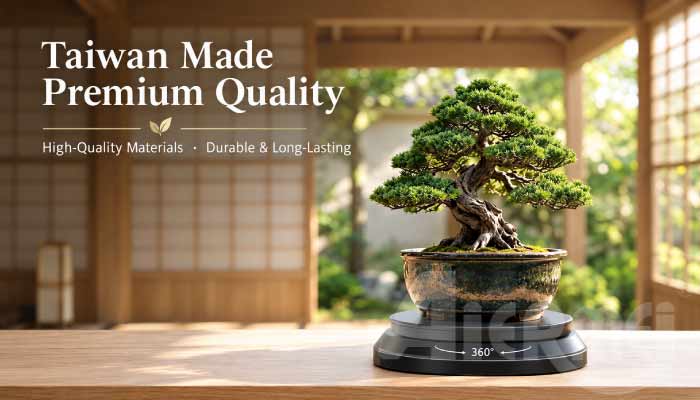
Beyond material, it's also worth considering where a product is manufactured. Aiermei turntables are made from PC Alloy Material and manufactured in Taiwan by You Sheng Plastics, a company with over 40 years of experience in plastics manufacturing. For a product that has to bear weight and rotate reliably every time, consistent manufacturing quality is a top priority.
How to Buy: Purchasing Channels and Bulk Order Notes
Where to Buy
To purchase a Round Turntable or Square-Base Round Turntable, contact Aiermei directly and choose based on the size and load capacity guidance above. Retailers, exhibitors, or anyone needing a larger quantity are also welcome to request a quote.
Estimating Bulk Order Quantity
- Count the actual number of placement points needed — for example, display spots and work areas.
- Set aside a small buffer stock based on intended use.
- Each turntable is individually packaged (1 unit per box) — calculate your total order by the box.
Receiving Goods and Handling Damage
- Confirm the specs and appearance match your order before opening the packaging.
- Record video while unboxing — if there's shipping damage, the video serves as the basis for resolving it.
- Once a product has been unpacked and used, returns and exchanges are not accepted.
Not sure which spec to choose? Tell us your plant's size and where you plan to place it, and Aiermei can help you work it out.
[PLEASE PROVIDE IMAGE URL AND ALT TEXT]
FAQ
Q. How often should I rotate my plant?
A common approach is to give it a quarter turn each time you water. If you notice the plant leaning noticeably to one side, turn it a bit more often. For pruning bonsai or working on a floral arrangement, just rotate it as needed while you work.
Q. Does a turntable actually help plant health? Does it really prevent lopsided growth?
Yes, but what it actually addresses is uneven light exposure. Plants are phototropic and grow toward their light source, so if one side consistently gets more light than the other, that side tends to grow lopsided or develop noticeably fuller foliage. A turntable lets every side face the light in turn, which reduces the chance of lopsided growth and keeps the overall shape more even. That said, if the ambient light is genuinely insufficient, the plant will still stretch and reach for light regardless — a turntable alone has limited effect in that case, and you'll also need to adjust placement or add supplemental lighting. A turntable is a helpful tool, but it doesn't replace proper light, watering, and nutrients.
Q. How do I clean and maintain a turntable?
Wipe the surface with a dry or slightly damp cloth. If soil or debris gets into the gaps, a soft brush works well for clearing it out. If it starts feeling stiff or sticky when you turn it, check first for anything caught inside.
Q. Can I put several plants on one turntable at the same time?
Yes — just keep the plants grouped toward the center with the weight evenly distributed, and make sure the combined weight stays within the load capacity. Avoid loading everything to one side, since that can make the whole setup unstable.
How to Decide
Choosing a plant turntable isn't about finding the cheapest option — it's about weighing several things together: use case × placement × size × load capacity × material × budget.
- For general personal use: measure your pot's base diameter, weigh the whole plant, then contact Aiermei and match against the specs above.
- For retailers, exhibitors, or bulk orders: contact Aiermei directly and we'll help assess the right fit based on your site and quantity.
Once you've found the right turntable, every watering, pruning session, and moment spent admiring your plant becomes noticeably easier. If you have any questions about specs, feel free to reach out to us.
[PLEASE PROVIDE IMAGE URL AND ALT TEXT]