- Blog
- 2026/09/17
If you're choosing a large plastic planter for a storefront, garden, commercial space, landscaping project, or outdoor installation, what actually matters usually isn't just "does it look good."
Will the planter fit through the elevator?
How much root space does the plant need?
Will it sit outdoors under prolonged sun exposure?
Does it drain well?
Once it's filled with growing medium and a plant, will it still be manageable to move?
And if you're buying in bulk for a landscaping project, how do you estimate quantity, packaging, shipping, and lead time?
This matters even more with large plastic planters — get the size or spec wrong, and you won't find out until you're on site and can't get it through the door, or the drainage doesn't work, and you end up having to re-arrange labor to move it. The downstream cost of that mistake is often far more of a headache than the price of the planter itself.
So when sourcing large plastic planters, don't just compare per-unit price — evaluate the plant, the site conditions, sizing, material, handling logistics, and order quantity together.
Below are the questions that come up most often when buying large plastic planters, to help you confirm the right spec before placing an order.
1. Scenario Fit and Plant Compatibility
What Plants Are Large Plastic Planters Suited For?
The core advantage of a large plastic planter (large tree pot) is its combination of high volume, stable soil moisture, and sufficient depth, giving plants ample room for root development:
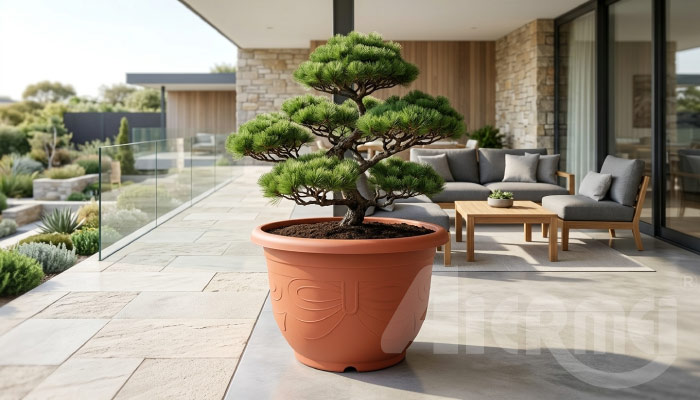
- Ornamental trees and small fruit trees: species such as Podocarpus macrophyllus, sweet olive, olive trees, lemon trees, kumquat, plumeria, and Juniperus chinensis. These species tend to have more developed root systems and need a deeper container (at least 40 cm deep is recommended) to accommodate the root ball.
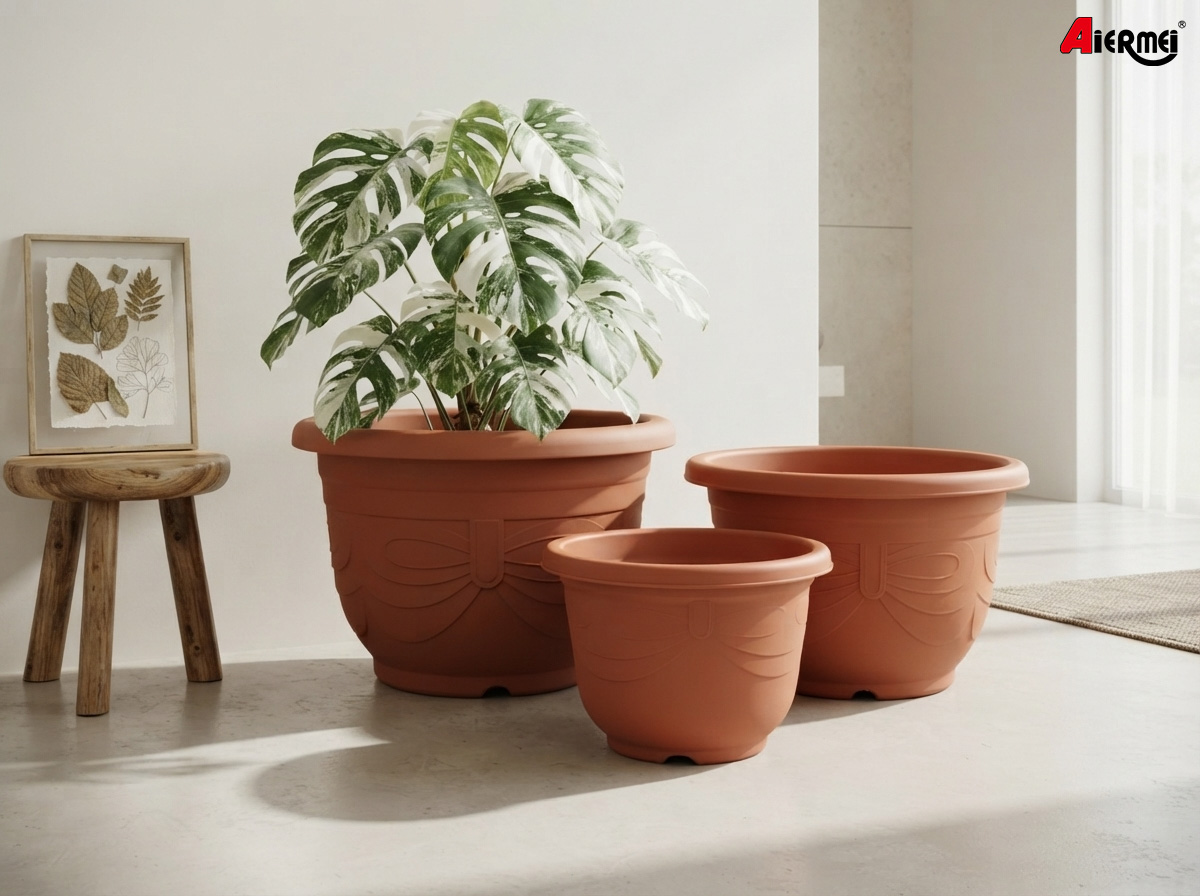
- Medium-to-large shrubs and foliage plants: species such as Monstera deliciosa, bird of paradise, or traveler's palm, as well as perennial herbaceous plants — well suited to a storefront entrance or courtyard for a layered visual effect.
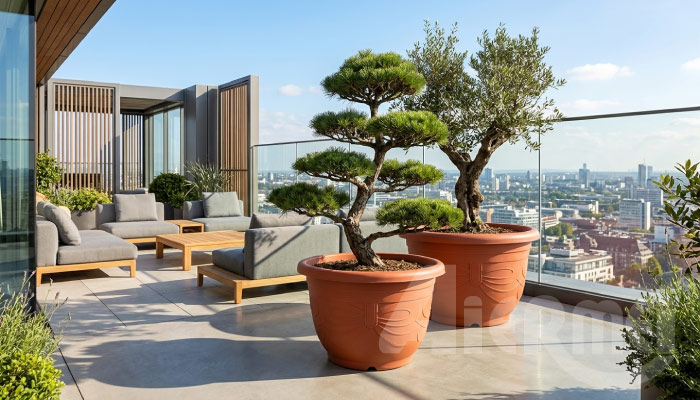
- High wind-exposure settings: rooftop gardens, balconies, terraces, or storefronts facing prevailing wind. A large planter filled with moist growing medium can weigh tens of kilograms, and that natural weight provides excellent wind stability.
Extension horticulture resources from North Carolina State University note that container choice should weigh material, size, drainage, and weight together. A larger-capacity container gives a plant more stable moisture and root space, which is especially useful for potted plants that need to be moved or repositioned frequently.
Popular Outdoor Use Cases and Configuration Tips
- Commercial spaces and storefront entrances: restaurants, cafés, or office building entrances can use tall or deep large tree pots (such as the L-206 Butterfly-Knot Round Pot) to establish a clear welcoming path and reinforce brand presence.
- Community courtyards and residential gardens: pairing planters of varying heights and diameters with foliage plants builds a rich sense of visual layering.
- Trade shows, event setups, and rental venues: compared to the intimidating weight of concrete planters, plastic planters are light and impact-resistant, making setup, teardown, transport, and plant swaps after an event far more efficient — a significant saving on labor cost.
3 Key Factors for Outdoor Weather Resistance: Sun, Drainage, and Stability
- UV-resistant formulation: budget resins tend to become brittle and fade under prolonged sun exposure — always confirm with the supplier whether UV stabilizers are added and what grade of resin is used.
- Even drainage design: a base with only one or two holes is highly prone to waterlogging and root rot during heavy rain. An ideal design has multiple evenly spaced drainage holes, paired with an adjustable elevated base to let water drain freely.
- Wind stability: a large, deep planter like the L-206 Butterfly-Knot Round Pot can easily weigh tens of kilograms once filled with growing medium — that weight alone helps keep it from tipping over in strong wind, making it a top choice for rooftop gardens over lighter materials.
(Drainage solution: 【Aiermei Nursery Bench】BNH-054 Nursery Display Bench (4 feet))
2. Sizing Specs and Taiwanese-Inch Conversion
Industry Taiwanese Inches (台吋) vs. Centimeters (cm)
In Taiwan's horticulture and landscaping industry, planter sizes are conventionally labeled in "Taiwanese inches" (1 Taiwanese inch ≈ 3.03 cm), which is different from the liter (L) capacity measurement commonly used overseas — don't mix the two up when sourcing.
【Practical Sizing Conversion Example】Using the L-206 Butterfly-Knot Round Pot:
- Catalog spec: 25 Taiwanese inches (diameter) × 15 Taiwanese inches (height)
- Approximate actual measurement: diameter 75 cm × height 46 cm (Note: actual dimensions are subject to the manufacturer's official spec sheet.)
On-Site Access Measurement Checklist
A large plastic planter becomes difficult to move once filled with growing medium, so before it arrives on site, be sure to measure:
- Elevator door width and car depth (will the large planter actually fit through the elevator?)
- Clear door height and hallway corner width
- Steps and door-frame obstructions along the transport route
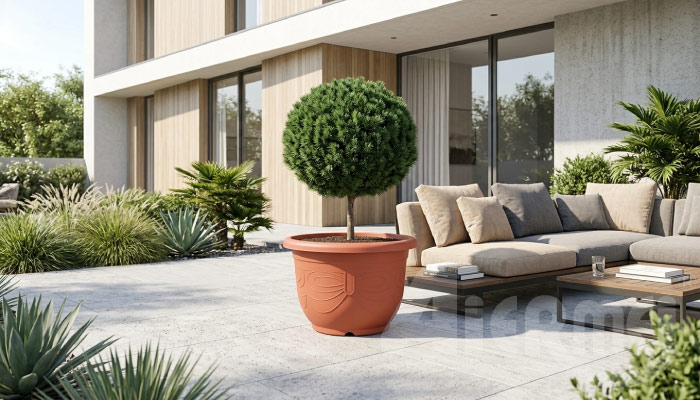
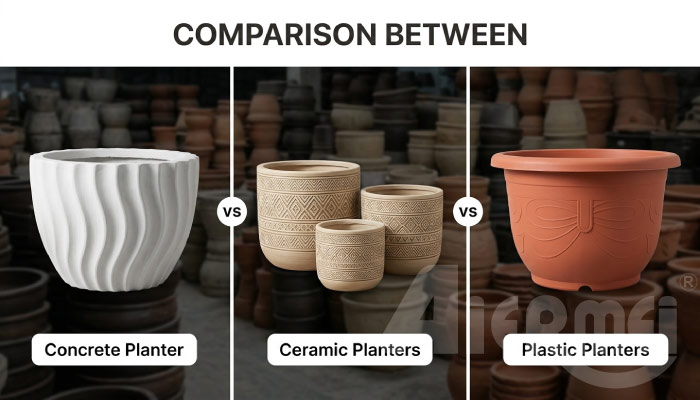
3. Pros, Cons, and Cost Comparison of 3 Planter Materials
There's no single correct answer when choosing a large planter — what matters is weighing on-site handling conditions, budget ceiling, and desired appearance:
|
Material |
Weight & Handling |
Outdoor Considerations |
Appearance |
Cost |
Common Use Cases |
|
Plastic |
Lighter, easier to move |
Confirm weatherability and UV design |
Wide range of styles |
Relatively easy to control |
Landscaping projects, storefronts, event setups, outdoor landscaping |
|
Ceramic / terracotta |
Heavier, prone to chipping on impact |
Assess by specific product |
Natural, classic |
Medium |
Gardens, feature landscaping |
|
Concrete |
Heavy, harder to move |
Common for fixed outdoor installations |
Solid, substantial |
Higher |
Fixed landscaping, large-scale spaces |
4. Project Procurement and Logistics Pitfalls to Avoid
Estimating Order Quantity (Layout Planning + Buffer Stock)
The worst approach to estimating order quantity is "guess roughly, reorder if short." A more reliable method:
- Calculate the site layout precisely: confirm how many planters the site can actually accommodate and how they'll pair with the planting plan.
- Reserve a 10% buffer: budget roughly 10% extra for on-site breakage or last-minute additions from the client, so you're not caught off guard.
- Match your order to carton packaging: for example, if planters ship 12 per carton and the site needs 30, adjust the order quantity to ship in full cartons, balancing shipping cost against delivery timing.
Loading/Unloading Method and Damage-Handling Terms
- Confirm loading/unloading equipment: large planters are bulky, so before quoting, confirm whether a standard delivery truck can unload directly on site, or whether a crane or forklift is needed.
- Shipping damage policy: in case of damage in transit, agree on a replacement/return policy and restocking turnaround with the supplier in advance (lead times routinely stretch longer during peak season).
【B2B Landscaping Projects and Materials Sourcing】
Planning a landscaping project, event installation, or need bulk materials wholesale?
[Click here to contact an Aiermei "Aiermei®" Project Consultant] for the latest full-carton wholesale pricing.
5. Frequently Asked Questions: What to Know Before Buying a Large Plastic Planter
Q1. How much load capacity does a large plastic planter need to grow a tree?
It depends on the tree species' root development and the planter's depth. As a general rule, choose a planter at least 40 cm deep with a well-designed drainage system, to avoid a shallow container restricting root development and affecting growth and wind resistance.
Q2. Which is more durable and cost-effective — plastic planters or terrazzo planters?
PP plastic planters are extremely lightweight (roughly 1/3 the weight of a terrazzo planter), making handling and installation faster, easier, and less prone to chipping or cracking. Terrazzo planters have a solid, substantial feel, but their material and handling costs are considerably higher. For project ROI and installation efficiency, plastic planters offer the best value.
Q3. How can I tell if a large plastic planter is suitable for outdoor use?
Proactively confirm with the supplier the resin grade used, whether UV stabilizers are added, the number of drainage holes, the weight, and the expected weatherability lifespan — don't judge outdoor suitability based on the words "large" or "plastic" alone.
Q4. How is wholesale pricing for plastic planters calculated, and how do I get the best rate?
Wholesale pricing is generally tied to total order quantity and the number of packed cartons. It's best to consolidate your needed Taiwanese-inch specifications, quantity, and expected lead time into a single, clear conversation at the planning stage, rather than repeatedly adjusting specs, which drags out quoting and shipping costs.
How to Choose a Large Plastic Planter: Start With "What You Need," Not the Price
Choosing a large planter isn't just about finding the cheapest option.
The right planter needs to satisfy all of the following at once:
Plant needs × Site conditions × Size × Material × Handling × Budget × Order quantity
For a typical garden or storefront, start by working out the plant and the space dimensions; for a landscaping project or bulk order, also factor in packaging, shipping, lead time, and supply capacity.
And if you're still not sure what size or spec you need, you can simply share your use case, plant type, expected quantity, and sizing needs with a large planter supplier and work from there — that tends to be far more efficient than browsing a product catalog cold.